Bilis Negra Solitude
for flute, 13 musicians and electronics
— About
The cycle Bilis Negra is inspired by depressive disorders. The first piece is written for solo flute, which in one section is prepared with a "Groan Stick" during an improvised passage. The ensemble of thirteen musicians is divided into three spatially separated groups, while the electronics are projected through a four-channel setup that fills the spaces between them.
Solitude also marks the beginning of Jorge Care's work with performance lighting. The hall remains completely dark, and each musician is equipped with a stand light to switch on or off as indicated in the score. These controlled shifts of light become a central dramaturgical element, shaping the perception of the spatialized ensemble and the electronics.
— Video documentation
Bilis Negra Mélancolie
for alto saxophone, 15 musicians and electronics
— About
Mélancolie continues the research into fragmented instrumental identities, spatial performance, and the integration of improvisation within mixed music. The alto saxophone is explored through multiple configurations including mouthpiece alone, mouthpiece with neck, and neck with body. At a key moment, it is prepared with a "Groan Stick" during an improvisation, revealing new timbral instabilities and extended spectra.
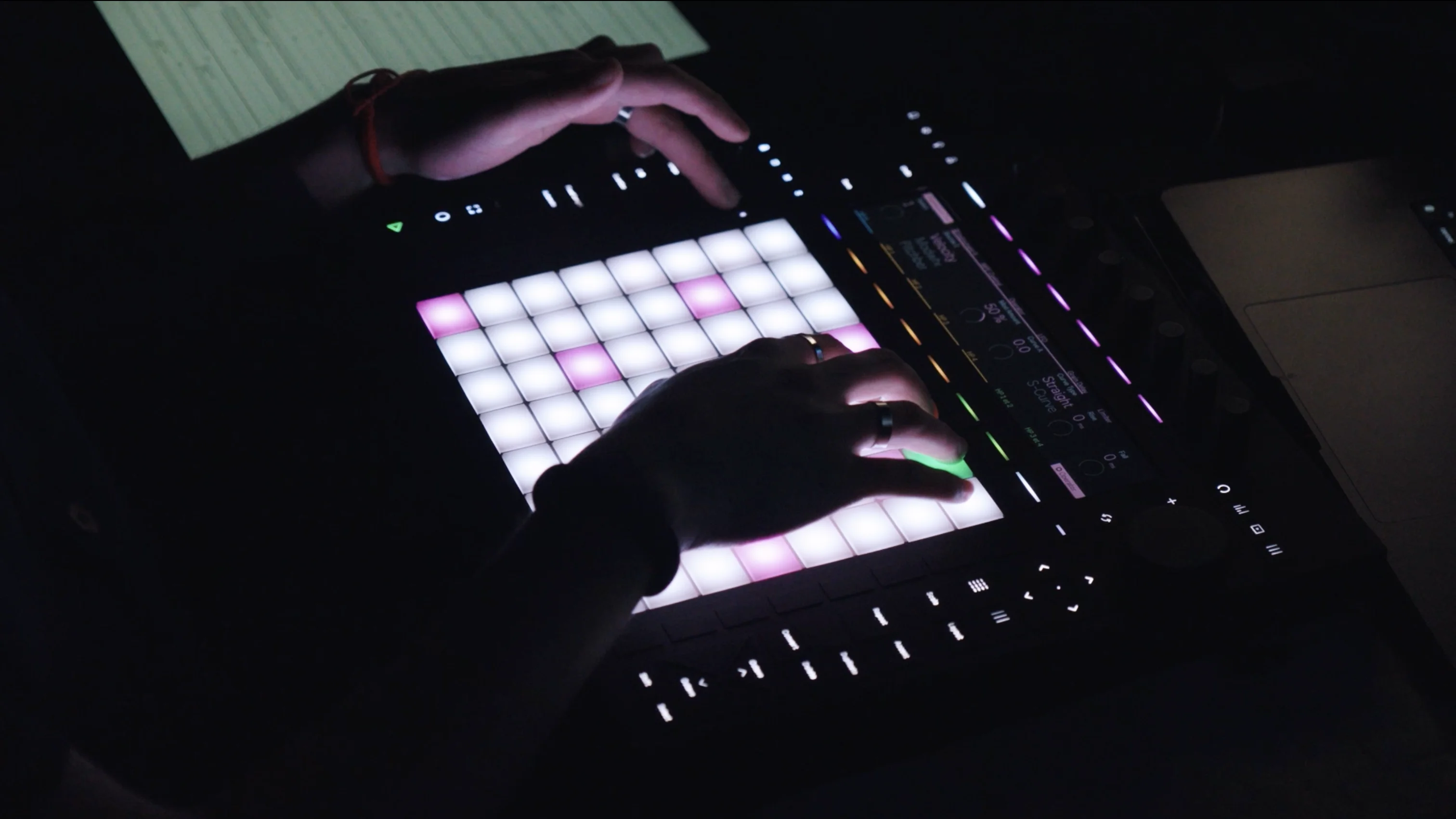
Improvisation becomes a shared framework: the soloist's material expands toward the ensemble, guided by a conductor who must improvise the gestures shaping the group's response. The electronic part is also performed live via Ableton Push, controlling an FM synthesis engine whose spatialization in quadraphonic, processed in real time with Panoramix, reinforces the sense of a moving sonic presence.
The ensemble is divided into three groups, each with a percussionist acting as a visual metronome for independent tempi. This polytempo structure is combined with a lighting design and a spatial trajectory in which the soloist begins outside the hall and gradually enters, creating a multidimensional environment in which perception, movement, and timbre remain in constant transformation.
— Video documentation